- Tree Tips · Palm Tree Care · Hurricane Prep · Palm Beach County
The #1 Tree Mistake Homeowners Make Before a Hurricane — The Hurricane Cut
By ArbolPro Services ISA-Certified Arborists · Palm Beach County, FL · Updated for the 2025 Hurricane Season
Why the most common pre-storm palm trimming practice in South Florida damages your trees, increases your risk, and what to do instead.
- ISA-Certified · Licensed & Insured · West Palm Beach
Every spring, as hurricane season approaches, we see the same thing on properties across Palm Beach County: palm trees stripped nearly bare, fronds removed all the way up to a small tuft at the top. The homeowner did it — or paid someone to do it — believing it would make the palm more storm-resistant.
It’s called the hurricane cut, and it’s one of the most damaging things you can do to a palm tree in South Florida.
The hurricane cut doesn’t reduce storm risk. In most cases, it increases it — while simultaneously stressing the tree, potentially killing it over the following season, and costing homeowners money they didn’t need to spend. This guide explains exactly why, what the research shows, and what proper pre-hurricane palm trimming actually looks like.
- What a hurricane cut is and where the practice came from
- The biology of why it harms palms
- The real risk increase it creates
- What correct pre-hurricane palm trimming looks like
- How to find someone who will do it right in Palm Beach County
What Is the Hurricane Cut — And Why Does Anyone Do It?
A hurricane cut — also called a hurricane pruning or hurricane trim — is the practice of removing all or nearly all of a palm’s fronds except for a small cluster at the very top. The result is a palm that looks like a telephone pole with a tuft of green at the crown.
The reasoning behind it sounds intuitive: less canopy means less wind resistance, which means the tree is less likely to fail in a storm. It’s the same logic behind why you’d fold in a sail before rough weather.
The problem is that a palm tree is not a sail. Its biology works completely differently from how most people assume — and the “logic” behind the hurricane cut, when applied to palms, produces the opposite of the intended result.
The practice spread largely through word of mouth and was picked up by non-certified crews who marketed it aggressively to homeowners before each storm season. It became self-reinforcing: customers asked for it because they’d seen their neighbors do it, companies offered it because customers asked, and the practice normalized before there was widespread public awareness of the damage it caused.
Today, the International Society of Arboriculture (ISA) explicitly recommends against it. The University of Florida’s Institute of Food and Agricultural Sciences (UF/IFAS) has documented its negative effects on palm health. It violates the ANSI A300 standards that govern professional tree care. And yet it persists — because it looks like something is being done.
What a Hurricane Cut Actually Does to a Palm Tree
To understand why the hurricane cut is harmful, you need to understand one fundamental fact about palm biology: a palm has one growing point.
That growing point is called the apical meristem or apical bud. It sits at the very top of the trunk, inside the crown shaft — the smooth, tightly wrapped column of leaf bases at the top of most palm species. Every new frond that the palm will ever produce comes from this single point.
Unlike a live oak or a slash pine, a palm cannot produce new growth from its trunk, its old fronds, or any other point on the plant. If the apical bud is damaged, the palm cannot recover. It will die — sometimes quickly, sometimes over the course of a season or two, but it will not put out new growth.
Here’s what removing the fronds aggressively does to that growing point:
It removes the protective buffer. The surrounding fronds protect the apical bud from direct exposure to wind, rain, salt spray, and temperature extremes. Strip those fronds and the bud is fully exposed to whatever conditions arrive with the storm.
It forces a resource crisis. Palms store significant nutrients — particularly potassium — in their fronds. When you remove those fronds, you eliminate the tree’s nutrient reserves at exactly the moment it needs them most. The palm must immediately redirect all available energy to producing new fronds, leaving nothing in reserve for structural stability or root maintenance.
It does not meaningfully reduce wind resistance. Research from UF/IFAS and independent arboricultural studies has consistently found that palm fronds flex with wind rather than catching it. They are not rigid sails. The fronds move with the wind, reducing — not increasing — lateral load on the trunk during a storm. The trunk itself is what the wind acts on, and removing fronds does not change the trunk’s profile or its structural loading.
The net result: a stressed tree with an exposed growing point, depleted nutrient reserves, and no measurable reduction in storm risk. In some documented cases, over-trimmed palms have shown higher rates of failure because a weakened root system — starved of photosynthetic energy — cannot maintain the tree’s anchorage.
The Hurricane Cut and Actual Storm Performance — What the Evidence Shows
After major storm events, arborists and researchers survey the damage patterns across affected areas. The data from South Florida storms consistently shows something counterintuitive: palms that were not aggressively trimmed before the storm often outperform those that were.
A palm with a full, healthy canopy going into a storm is not carrying a liability. It is carrying a structural advantage. The flexible fronds move with the wind, distributing load across the canopy. The intact root system — supported by regular photosynthesis from a full canopy — is better anchored. The apical bud is protected by surrounding fronds.
Contrast that with an over-trimmed palm: a root system that has been starved of photosynthetic energy for months, an exposed apical bud, and depleted nutrient reserves. If high winds arrive, this tree has less resilience, not more.
None of this means a properly maintained palm will never fail in a storm. It means the hurricane cut does not improve the odds and likely worsens them — particularly for palms that are already nutrient-stressed, which describes a significant percentage of palms in Palm Beach County’s sandy soils.
What does reduce storm risk in palms? Removing dead fronds, fruit stalks, and boots (old frond bases) that have adhered to the trunk. These items are genuinely loose material that can become projectiles. A correctly trimmed palm — which loses this material and nothing else — is meaningfully better prepared for a storm than one that was hurricane cut.
What Correct Pre-Hurricane Palm Trimming Looks Like
The standard used by ISA-certified arborists for palm trimming is sometimes called the 10 o’clock to 2 o’clock rule, or more commonly the 9–3 rule: imagine a clock face overlaid on the palm. Fronds below the 9 o’clock position on the left and 3 o’clock position on the right — below the horizontal line — may be removed. Everything above that line stays.
In addition to position, fronds that qualify for removal include:
- Dead fronds (brown, fully dry, hanging downward)
- Fruit stalks and seed clusters — these are genuinely loose and can detach in wind
- Boots (old frond bases that have dried and adhere to the trunk) — on species where they accumulate
- Fronds that are diseased or showing signs of pest damage
What should not be removed:
- Any green frond above the horizontal line
- Fronds that appear yellowing but are still attached and partially green — these are still photosynthesizing
- The crown shaft itself — this should never be cut, trimmed, or disturbed
A correctly trimmed palm looks like a palm that has been maintained — not one that has been stripped. If the palm you’re looking at has more fronds removed than retained, something went wrong.
One practical note: the timing of the trim matters. Trimming in March or April — 6–10 weeks before June 1 — gives the palm time to stabilize before storm season. Trimming in late May or early June, just before the season starts, leaves the palm stressed going into the highest-risk period. See our full guide to when to trim trees before hurricane season in South Florida.
Think Your Palms Were Hurricane Cut? We Can Assess the Damage — Free
How to Tell If a Company Is About to Hurricane Cut Your Palms
This is a practical question with a practical answer. Before any crew starts work on your palms, ask one question:
“Where will you stop removing fronds?”
If the answer is “we’ll take off everything except a few at the top” or “we’ll give it a hurricane trim” — that’s the signal to stop them. A crew that understands correct palm trimming will describe the 9–3 rule, the horizontal line, or the clock position method without prompting.
Additional warning signs:
- The company uses the phrase “hurricane cut” as a selling point rather than a reason to avoid
- They quote the job by how many fronds they’ll remove rather than by the condition of the palm
- They can’t identify the specific palm species before quoting (different species have different crown management needs)
- No one on the crew has ISA certification or can produce credentials
- The price is significantly lower than other quotes — which often reflects a fast, non-specialist job
Always verify that your tree service company carries active liability insurance and can provide a Certificate of Insurance (COI) upon request.
At ArbolPro Services, every palm trimming job is assessed and overseen by an ISA-certified arborist. We don’t offer hurricane cuts because they cause more harm than good. We offer correct trimming that actually prepares your palms for the season.
The Hurricane Cut Problem Across Palm Beach County
We see hurricane cut damage on properties throughout Palm Beach County every spring. Some areas are more affected than others — largely based on how many non-certified crews operate in that neighborhood and how aggressively they market pre-season trimming.
West Palm Beach properties frequently show the aftermath of hurricane cutting on Royal Palms, Sabal Palms, and Coconut Palms. The density of residential properties and the high number of competing tree service companies creates conditions where the hurricane cut gets offered frequently and accepted because it’s familiar.
Wellington and Palm Beach Gardens — both areas with significant palm coverage across larger lots — tend to see the damage on larger, more mature palms where the economic loss of killing a 30-year-old Queen Palm is substantial. Replacing a mature palm in these communities costs significantly more than a correct trimming would have.
Jupiter and Boca Raton coastal properties often have Coconut Palms and Date Palms that are particularly sensitive to over-trimming. The combination of salt air stress and an aggressive hurricane cut can accelerate decline faster than in inland areas.
Delray Beach, Boynton Beach, and Pompano Beach all have established residential palm canopies that are vulnerable to the same pattern. Homeowners in these communities sometimes inherit previous hurricane cut damage when they purchase a property — palms that look alive but have compromised nutrient reserves and are producing smaller fronds with each cycle.
The good news: a palm that was hurricane cut once and survived can often recover fully with correct maintenance over the following 2–3 seasons — provided the apical bud was not damaged and potassium supplementation addresses the nutrient deficit.
Free
On-Site Estimates
- Pricing Guide
What Correct Palm Trimming Costs — And What Replacing a Dead Palm Costs
Correct palm trimming in Palm Beach County typically runs $150–$400 per palm depending on height and species. A Sabal Palm at 20 feet is at the lower end. A Date Palm at 40 feet with significant boot accumulation is at the higher end.
That cost covers the assessment, removal of appropriate material, cleanup, and haul-away. It does not involve stripping the tree — which is why it sometimes takes less time and costs slightly less than a hurricane cut from a non-specialist crew.
Compare that to the cost of replacing a palm that was killed or permanently damaged by a hurricane cut:
- A 10-foot Sabal Palm replacement: $400–$800 installed
- A 20-foot Royal Palm replacement: $1,500–$3,500 installed
- A mature Coconut Palm or Date Palm: $2,000–$6,000+ installed, depending on specimen size
The math is straightforward. Correct trimming done once a year costs less than replacing a single palm. A hurricane cut that kills a mature specimen costs multiples of what the trimming would have cost.
All palm trimming estimates from ArbolPro Services are free, on-site and in writing before any work begins. See our full tree trimming service page for more.
- Free on-site estimates — written before any work begins
- Multi-palm discount available on the same visit
- Palms and hardwoods combinable in one appointment
When to Call a Professional for Palm Trimming Before Hurricane Season
The short answer: before anyone else touches the trees.
If you have palms on your property and haven’t had them assessed by an ISA-certified arborist in the last 12–18 months, a pre-season assessment is worth scheduling. An arborist will tell you which fronds actually need to come off, which palms have underlying health issues that a trim won’t fix, and what your trees genuinely need before June.
Call a professional if:
- Your palms haven’t been trimmed in two or more years — accumulated dead fronds and boots create genuine storm hazards
- You’ve had them hurricane cut before and want to understand whether recovery is possible
- Your palms are showing yellowing fronds — this may indicate potassium deficiency that needs treatment, not just trimming
- You have Coconut Palms with heavy fruit loads approaching storm season — fruit removal is important and separate from frond trimming
- Your palms are near structures and you want an honest assessment of their condition and storm risk
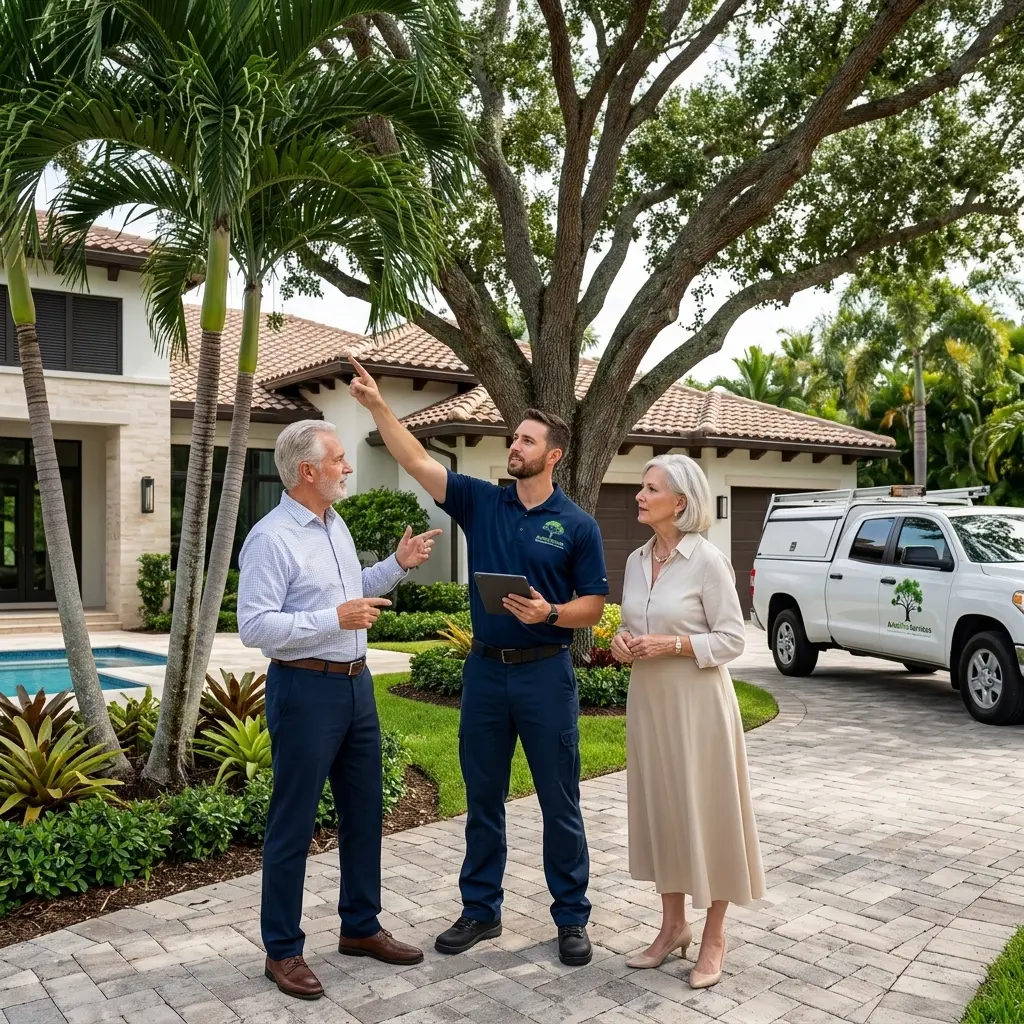
At ArbolPro Services, our ISA-certified arborists provide free on-site assessments across Palm Beach County. We’ll walk your property, evaluate each palm individually, and give you a written quote before we schedule any work. Call us at (728) 209-4532 or request an estimate online.
- Frequently Asked Questions
The Hurricane Cut — Frequently Asked Questions
Common questions from Palm Beach County homeowners about pre-storm palm trimming.
When is the best time to trim trees in Palm Beach County before hurricane season?
A hurricane cut is the practice of removing nearly all of a palm’s fronds before storm season, leaving only a small cluster at the top. It’s done under the belief that less canopy means less wind resistance. In practice, it stresses the tree, exposes the apical bud, depletes nutrient reserves, and does not meaningfully reduce storm risk. It is specifically discouraged by the International Society of Arboriculture and violates ANSI A300 standards.
How much of a tree should you trim before a hurricane?
Removing appropriate fronds — dead ones, fruit stalks, and boots below the horizontal line — does help. Removing healthy green fronds does not. Palm fronds flex with wind rather than acting as rigid sails, so stripping them does not reduce the aerodynamic load on the trunk. What it does do is remove the palm’s nutrient reserves and expose the apical bud. Correct, targeted frond removal is beneficial. Over-removal is harmful.
Should you trim palm trees before a hurricane in South Florida?
The industry standard is the 9–3 rule: imagine a clock face on the palm and remove fronds below the 9 o’clock and 3 o’clock positions — below the horizontal line. Green fronds above that line should not be removed. Additionally, remove fruit stalks, seed clusters, and dry dead fronds regardless of position. This is the trim that prepares the palm for storm season without damaging it.
Does trimming trees before a hurricane actually help?
Often yes — if the apical bud was not damaged during the cut and if the palm receives correct care afterward. A palm that was hurricane cut but survived with its crown shaft intact can recover over 2–3 seasons with proper trimming and potassium supplementation to address nutrient depletion. A palm whose crown shaft or apical bud was nicked, penetrated, or damaged during aggressive trimming will decline and cannot be saved.
How soon before hurricane season should trees be trimmed in Florida?
Ask directly: “Where will you stop removing fronds?” A qualified crew will describe the 9–3 rule or the horizontal line method without prompting. If they describe removing everything except a few fronds at the top, or if they use the phrase “hurricane cut” as a selling point, stop them. Also verify ISA certification — you can check credentials through the ISA’s online arborist lookup at treesaregood.org.
The Bottom Line
The hurricane cut is the most common pre-storm palm trimming mistake in South Florida — and one of the most avoidable. It removes the fronds that protect the apical bud, depletes the nutrient reserves the palm needs to anchor itself, and provides no meaningful reduction in wind resistance. It doesn’t make palms safer. It makes them less healthy going into the conditions that require the most from them.
Correct palm trimming — following the 9–3 rule, removing dead material and fruit stalks, leaving green fronds intact — takes no more time, often costs no more, and actually prepares your palm for the season. The difference is whether the person doing the work knows what they’re doing.
If you’re in Palm Beach County and your palms need pre-season attention, ArbolPro Services provides ISA-certified arborist assessments and correct palm trimming across the county. Free estimates, written quotes, no hurricane cuts.
- Get Started
Need a Free Quote in Palm Beach County?
Need a free quote in Palm Beach County? Contact ArbolPro Services today or call (728) 209-4532. We serve West Palm Beach, Boca Raton, Wellington, Jupiter, Palm Beach Gardens, Delray Beach, Boynton Beach, and Pompano Beach.
Free estimates Mon–Sat · ISA-Certified Arborists · No hurricane cuts
✓ Licensed & Insured ✓ Written Quote ✓ No Subcontractors ✓ Palm Beach County