Tree Tips
Palm Health Guide
- Tree Tips · Palm Tree Health · Palm Beach County
Why Is My Palm Tree Turning Yellow? A Homeowner's Diagnostic Guide
By ArbolPro Services ISA-Certified Arborists · Palm Beach County, FL · Palm Health Guide
Five causes of yellow fronds on palms in South Florida — which are normal, which need treatment, and which are fatal if ignored.
- ISA-Certified · Licensed & Insured · West Palm Beach
A palm tree turning yellow is one of the most common calls we get from homeowners across Palm Beach County. The concern is understandable — yellow fronds look alarming, especially when the palm looked fine two weeks ago.
The reality is that yellowing fronds can mean five different things, ranging from completely normal to a disease with a 100% fatality rate that spreads to neighboring palms. Knowing which situation you’re dealing with determines whether the right response is to do nothing, apply fertilizer, call a pest control company, or call an arborist immediately.
This guide walks through the five most common causes of palm yellowing in Palm Beach County, how to distinguish them from the ground, and what action — if any — each one warrants. It’s based on what our ISA-certified arborists see on properties in West Palm Beach, Boca Raton, Wellington, Jupiter, and surrounding areas every season.
- Normal senescence — the one that requires nothing
- Potassium deficiency — the most common fixable cause
- Magnesium deficiency — often misdiagnosed
- Lethal Bronzing disease — fatal, spreads to neighbors
- Overwatering and root stress — a common error in irrigated landscapes
Cause #1: Normal Frond Senescence — When Yellow Is Not a Problem
Before diagnosing a problem, it helps to know what normal looks like.
Palms replace their fronds continuously. Old fronds age, turn yellow, then brown, and die — while new fronds emerge from the crown. This cycle is normal for every palm species found in Palm Beach County, and the rate varies by species, age, and growing conditions.
If the yellowing is limited to the oldest fronds at the bottom of the canopy — below the horizontal midline of the crown — and the rest of the canopy looks green and healthy, this is almost certainly normal senescence. The palm is cycling out old fronds.
Sabal palms (the Florida state tree, common throughout Palm Beach County) are particularly prone to producing large quantities of dead lower fronds. A Sabal palm with a skirt of brown and yellow fronds at the base is not sick — it’s a Sabal palm.
What does not indicate normal senescence:
- Yellowing that starts in the middle or upper canopy rather than at the bottom
- Yellowing that progresses rapidly — weeks rather than months
- Fronds that are yellow-orange with a necrotic (dead) tip rather than evenly yellowing
- Yellowing accompanied by stunted new growth at the crown
If you’re unsure whether you’re looking at normal cycling or something else, the location of the yellowing in the canopy is the first thing to establish. Bottom of the canopy: likely normal. Anywhere else: read on.
Cause #2: Potassium Deficiency — The Most Common Treatable Cause in Palm Beach County
Potassium deficiency is the single most common nutritional problem affecting palms in South Florida. It’s so common that most ISA-certified arborists treating palms in Palm Beach County, Boca Raton, and surrounding areas encounter it regularly — and the sandy soils throughout the region are a primary reason why.
Sandy soils don’t hold potassium well. Rain and irrigation wash it through the root zone before the palm can fully utilize it. On top of that, many homeowners (and many landscaping crews) fertilize with standard turf fertilizers that are high in nitrogen but low in potassium — which accelerates the problem by pushing canopy growth without the micronutrient support to sustain it.
What potassium deficiency looks like:
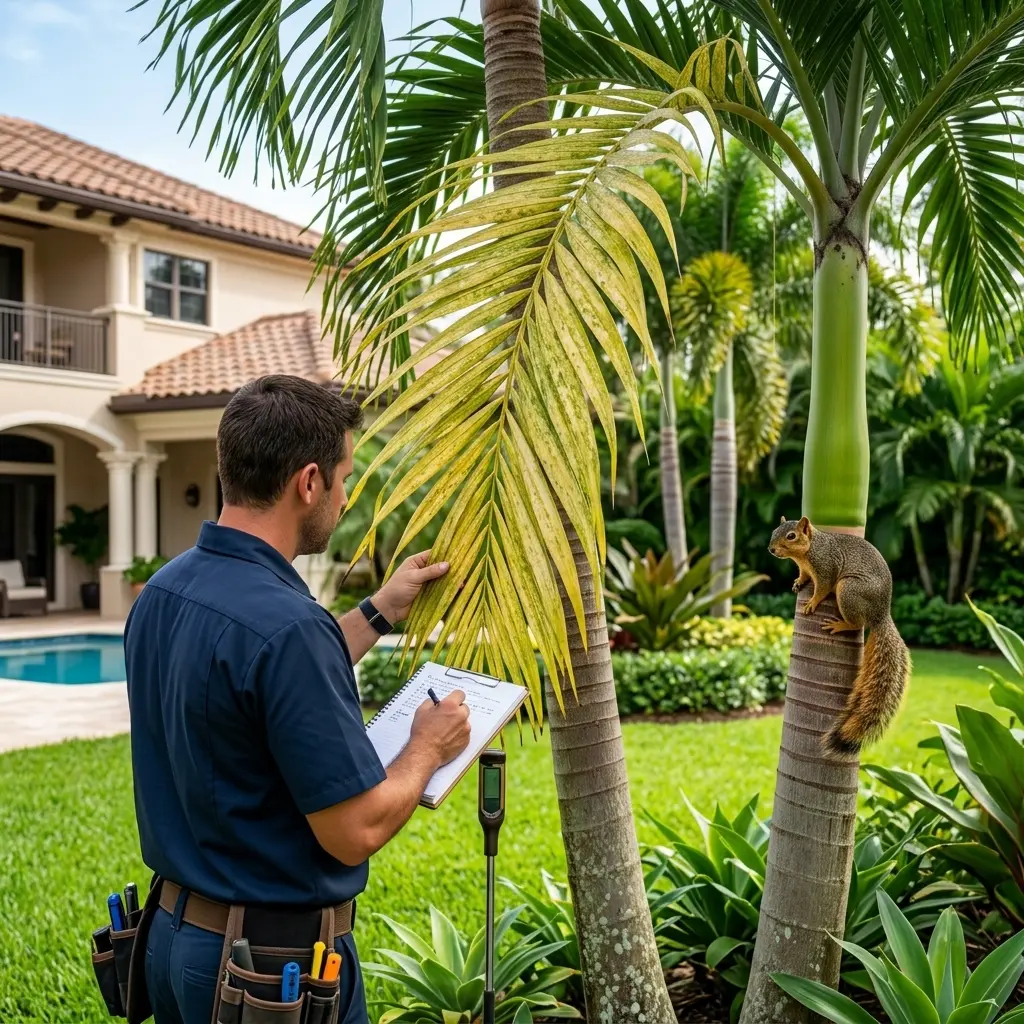
- Yellow-orange to brownish-orange discoloration on the tips and margins of older fronds — not the whole frond
- The discoloration starts at the frond tips and progresses inward
- In advanced cases, the entire older frond becomes orange-bronze before dying
- Newer fronds may appear smaller than normal
- The newest fronds at the crown typically look greener than the older ones
What to do: Potassium deficiency is treatable with the correct palm-specific fertilizer. The University of Florida IFAS recommends a slow-release palm fertilizer with an 8-2-12-4Mg (or similar) NPK+Mg analysis applied quarterly. Standard turf fertilizers make the problem worse. Do not apply turf fertilizer to your palms.
Important: potassium that is already in deficient fronds cannot be recovered. Treatment stops further decline and promotes healthy new growth — but existing fronds don’t turn green again. Be patient. Improvement shows in the new growth that emerges over the following 3–6 months.
If the deficiency is severe or if you’re not confident in the diagnosis, an arborist assessment before you start fertilizing is worth the time. Misidentifying potassium deficiency as Lethal Bronzing — or vice versa — has very different consequences.
Cause #3: Magnesium Deficiency — Often Confused With Potassium
Magnesium deficiency is the second most common nutritional issue we see in palms across Palm Beach County. It’s frequently misdiagnosed — either as potassium deficiency (the symptoms overlap) or as disease (the yellowing can look alarming).
What magnesium deficiency looks like:
- A broad yellow band along the margins of older fronds, with the center of the frond remaining green — creating a two-toned appearance
- The central leaflets stay green while the outer leaflets yellow
- Affects older fronds first, working upward over time
- Common on Queen Palms, Phoenix Palms (Date Palms), and Pygmy Date Palms
The two-toned frond — green center, yellow margins — is the key distinguishing feature from potassium deficiency, which tends to produce a more uniform tip-to-base orange-brown pattern.
What to do: Apply a palm fertilizer with adequate magnesium. In cases of visible deficiency, supplemental magnesium sulfate (Epsom salt applied to the soil, not the fronds) can provide faster correction while a palm-specific slow-release fertilizer builds up in the root zone. The UF/IFAS palm nutrition guidelines are the most reliable reference for South Florida conditions.
Like potassium deficiency, existing fronds will not recover. New growth should show improvement within 3–6 months of correct treatment. If you have a mix of magnesium and potassium deficiency — which is common — a palm fertilizer that addresses both simultaneously is more effective than treating each separately.
Cause #4: Lethal Bronzing Disease — The One That Cannot Be Ignored
Lethal Bronzing (LB), formerly called Texas Phoenix Palm Decline, is a fatal phytoplasma disease spread by a sap-sucking insect called the mole cricket leafhopper (Cedusa sp.). It has been spreading through South Florida since it was first detected in the state around 2006, and Palm Beach County properties — particularly those with Date Palms, Bismarck Palms, and Sabal Palms — are at meaningful risk.
Why Lethal Bronzing is in a category of its own:
- There is no cure once a palm is infected
- Infected palms die — typically within 3–5 months of symptom onset
- The insect vector spreads the disease to neighboring palms
- Preventive antibiotic treatment (oxytetracycline HCl injections) can protect healthy palms near an infected one, but cannot save an already-infected palm
What Lethal Bronzing looks like:
- Premature fruit drop — often the first symptom, occurring before visible frond changes
- Inflorescence (flower spike) necrosis — the flower spike browns and dies
- Fronds begin bronzing from the bottom of the canopy upward — a rapid, progressive browning that is different from normal senescence
- The spear leaf (the newest, unopened frond) eventually collapses
- Disease progression from first symptoms to death is typically 3–5 months
Most susceptible species in Palm Beach County: Canary Island Date Palm (Phoenix canariensis), Sylvester Palm (Phoenix sylvestris), Sabal Palm (Sabal palmetto), Bismarck Palm (Bismarckia nobilis), Foxtail Palm (Wodyetia bifurcata).
What to do: If you suspect Lethal Bronzing, do not wait. Call an arborist or contact your local UF/IFAS Extension office for assessment. If confirmed, the infected palm should be removed promptly to reduce further spread of the insect vector. Neighboring susceptible palms can receive preventive oxytetracycline HCl trunk injections every 4 months — this does not cure the disease but can protect healthy palms that haven’t yet been infected.
For more detail on Lethal Bronzing in Palm Beach County, see our dedicated guide: Lethal Bronzing Disease in Palm Beach County — What Every Palm Owner Needs to Know.
Cause #5: Overwatering and Root Stress — A Common Error in Irrigated Landscapes
Palm trees in Palm Beach County are often in irrigated landscapes — HOA common areas, residential lawns, and commercial properties where irrigation systems run on timers regardless of rainfall. Overwatering is more common than most homeowners realize, and it causes root stress that shows up as yellowing fronds.
The symptoms of overwatering in palms overlap with nutritional deficiency and can be difficult to distinguish without knowing the irrigation history of the property. The key question: has the irrigation schedule been adjusted for recent rainfall? In Palm Beach County’s rainy season (June through October), automatic irrigation systems often continue running at the same frequency they ran in the dry season — which means palms are receiving significantly more water than they need.
Signs of overwatering in palms:
- Generalized yellowing that doesn’t follow the bottom-up pattern of nutritional deficiency
- Soft or mushy areas at the base of the trunk
- Soil that remains saturated more than 24 hours after rain or irrigation
- Fungal growth at the base of the palm
- Wilting or drooping fronds despite adequate water (a counterintuitive sign that roots are damaged)
What to do: Reduce irrigation frequency. Palms in South Florida’s rainy season typically need no supplemental irrigation. In the dry season, watering 2–3 times per week at most is adequate for established palms in well-draining sandy soil. If the palm has been chronically overwatered, root rot may have set in — a situation where a professional assessment can determine whether recovery is possible.
A less common but related issue is salt accumulation from irrigation with reclaimed water, which is widespread in Palm Beach County. Reclaimed water has higher salt concentrations than potable water. Over time, salt accumulates in the root zone of irrigated palms and causes symptoms similar to drought stress — paradoxically, a palm that’s being watered regularly can show signs of stress from salt damage to its roots.
Rapid Yellowing or Top-Down Progression? That Needs Immediate Attention
Yellow Palms Across Palm Beach County — What We See by Area
The most common causes of palm yellowing vary somewhat by neighborhood and property type across Palm Beach County.
West Palm Beach residential properties tend to see a combination of potassium deficiency (from sandy soils and turf-focused fertilizer programs) and normal senescence on Sabal Palms. Properties near the Intracoastal with older Queen Palms frequently show magnesium deficiency alongside potassium issues.
Wellington and Loxahatchee properties — on larger lots with more established landscaping — often have irrigation systems that haven’t been recalibrated in years. Overwatering-related stress and root problems are a recurring finding during palm assessments in this area.
Jupiter and Palm Beach Gardens coastal properties deal with the full range: nutritional deficiency from salt-affected sandy soils, salt spray effects on frond health, and elevated Lethal Bronzing risk in areas where the disease has been documented in the county’s northern reaches.
Boca Raton and Delray Beach HOA communities typically have uniform palm species — often Sylvester Palms, Queen Palms, or Sabal Palms — installed as part of the original landscape design. When one palm shows yellowing, others in the same installation frequently have the same issue, which suggests a systemic nutritional or management problem rather than an isolated case.
Boynton Beach and Pompano Beach properties, particularly those near the coast, see increased salt spray effects during storm season that can cause temporary yellowing and frond tip burn independent of nutritional status. This resolves on its own once regular rainfall resumes and shouldn’t trigger an aggressive intervention.
If you’re not sure what you’re looking at on your property, a free on-site assessment will tell you. Getting the diagnosis right before spending money on fertilizer — or before a Lethal Bronzing case spreads to neighboring palms — is worth the time.
Free
On-Site Palm Assessments
- Pricing Guide
What Diagnosing and Treating Yellow Palms Costs in Palm Beach County
The cost of addressing a yellowing palm depends entirely on the cause.
Nutritional deficiency (potassium or magnesium): The primary cost is fertilizer. A palm-specific slow-release fertilizer adequate for one treatment cycle runs $20–$60 per palm depending on the product and application rate. Professional application by a licensed fertilizer applicator or arborist adds a service charge. Full recovery typically requires 3–4 treatment cycles over 12–18 months.
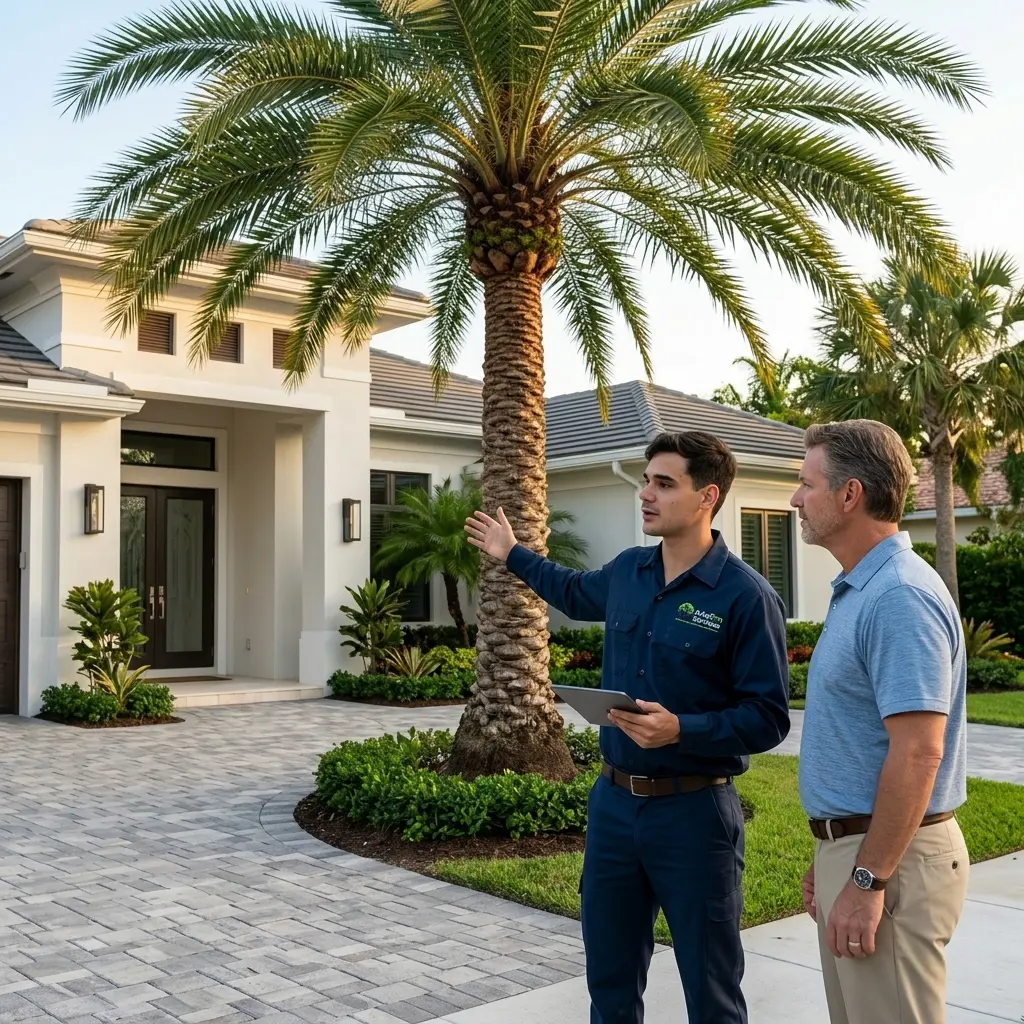
ISA-certified arborist assessment: ArbolPro provides free on-site palm assessments across Palm Beach County. We evaluate the palm, identify the most likely cause of yellowing, and recommend the appropriate treatment before any work is scheduled.
Lethal Bronzing — preventive treatment for neighboring palms: Oxytetracycline HCl trunk injections to protect healthy palms near a confirmed case run $150–$400 per palm per treatment, with treatments required every 4 months for ongoing protection. This is a significant cost — but removing and replacing a mature Date Palm or Bismarck Palm can cost $2,000–$6,000+.
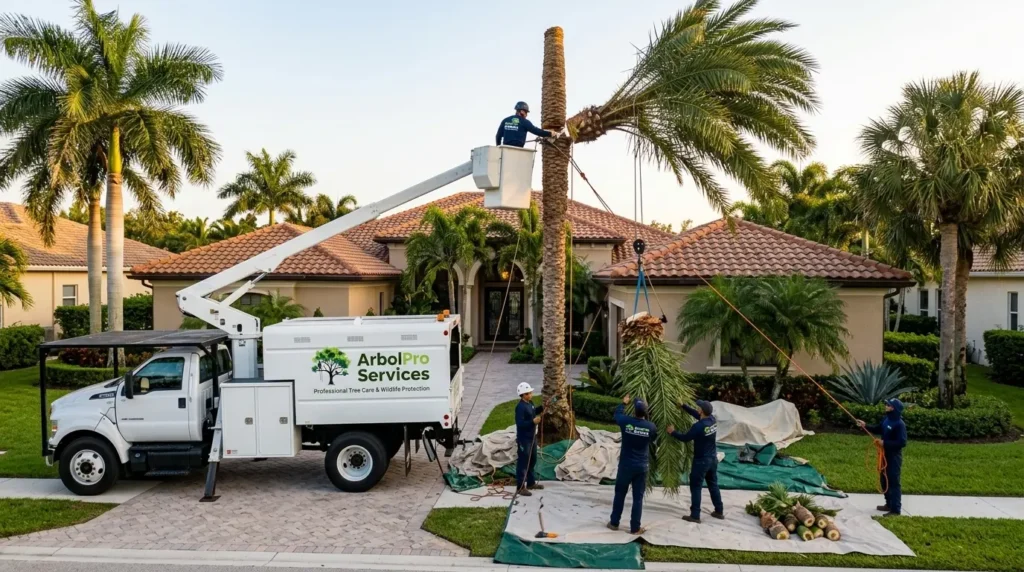
Infected palm removal: Standard palm removal pricing applies — typically $300–$700 for a palm under 25 feet in a residential setting, more for taller palms or confined spaces. See our palm trimming and removal service page for more detail.
Getting the diagnosis right before starting any treatment saves money and prevents making a manageable situation worse. A free assessment is the right first step.
- Free on-site palm assessment — no obligation
- Written quote before any treatment begins
- Correct diagnosis before spending money on fertilizer
When to Call a Professional About a Yellowing Palm — And When You Can Wait
Not every yellow palm is an emergency. Here’s how to calibrate when to act quickly versus when to wait and observe.
Call a professional promptly if:
- The yellowing started at the top of the canopy or is progressing upward from the middle — not from the bottom
- The palm is dropping fruit prematurely or flower spikes are dying
- Progression is rapid — visible change over days or a week or two
- You have a Date Palm, Bismarck Palm, Foxtail Palm, or Sabal Palm showing any of the above
- A neighbor’s palm recently died or is showing similar symptoms
- You have multiple palms in the same landscape all showing yellowing simultaneously
You can observe and wait if:
- Yellowing is confined to the bottom 20–30% of the canopy and the palm has looked this way for months
- The upper canopy and new growth at the crown are green and appear healthy
- The yellowing appeared in the wake of recent heavy rain or after an irrigation schedule change
When in doubt, a free assessment from an ISA-certified arborist is the fastest way to a definitive answer. Our arborists assess palms across Palm Beach County — West Palm Beach, Boca Raton, Wellington, Jupiter, Palm Beach Gardens, Delray Beach, Boynton Beach, and Pompano Beach. Call (728) 209-4532 or request an estimate online.
- Frequently Asked Questions
Palm Tree Turning Yellow — FAQ
Common questions from Palm Beach County homeowners about yellow palm fronds.
Why are the bottom fronds of my palm turning yellow?
Yellow fronds at the bottom of the canopy are most commonly normal senescence — the palm cycling out old fronds as new ones emerge from the crown. This is expected behavior for all palm species. If the upper canopy and new growth look green and healthy, and the yellowing is progressing slowly over months rather than weeks, no action is needed beyond removing the dead fronds when they are fully brown. If the yellowing is advancing rapidly or involves fronds higher in the canopy, read on for other potential causes.
What is the most common reason palm trees turn yellow in South Florida?
Potassium deficiency is the most common cause of palm yellowing across Palm Beach County and South Florida generally. Sandy soils leach potassium rapidly, and many landscape fertilizer programs use turf fertilizers that are low in potassium. The symptom pattern is tip-and-margin yellowing on older fronds that progresses inward. Treatment requires a palm-specific slow-release fertilizer with adequate potassium — not standard turf fertilizer, which can worsen the condition.
Can a yellow palm tree be saved?
It depends on the cause. Nutritional deficiency — potassium or magnesium — is treatable, and affected palms can recover fully with correct fertilizer applications over 12–18 months. Overwatering stress can be reversed if caught early. Lethal Bronzing disease cannot be treated in an infected palm — it is fatal once symptoms appear. A palm showing yellowing from Lethal Bronzing will die. The urgency of diagnosis is highest for palms showing rapid, top-down or mid-canopy yellowing, particularly on susceptible species like Date Palms and Bismarck Palms.
How do I know if my palm has Lethal Bronzing?
The earliest signs of Lethal Bronzing are often missed: premature fruit drop and flower spike necrosis before any frond yellowing appears. When frond yellowing does begin, it typically starts at the bottom of the canopy and moves upward, but progresses rapidly — weeks rather than months. The spear leaf — the apical frond at the very top, still unopened — eventually collapses. If you have a Date Palm, Bismarck Palm, Sabal Palm, or Foxtail Palm showing any of these symptoms, call an arborist rather than waiting to see how things develop.
Should I cut off yellow palm fronds?
Yellow fronds that are still partially green are still photosynthesizing and providing nutrient reserves to the palm — do not remove them. Removing yellow-green fronds accelerates nutrient depletion, which can worsen deficiency symptoms. Wait until a frond is fully brown and dry before removing it. Never remove more than the fronds below the horizontal 9–3 line in a single trimming session, regardless of their color. Over-trimming — particularly removing too many fronds at once — stresses the palm and can compound an existing nutritional problem.
The Bottom Line
A palm tree turning yellow isn’t always a crisis — but it isn’t always something to dismiss either. The five causes covered here range from normal aging to a fatal, spreading disease, and the right response to each is completely different.
The most important distinction to make early: is the yellowing progressing from the bottom of the canopy upward (usually nutritional or normal aging), or from the middle or top downward (potentially Lethal Bronzing or serious root stress)? Direction and rate of progression are the two variables that most efficiently point toward the correct diagnosis.
If you’re in Palm Beach County and your palm tree is turning yellow in a way that concerns you, ArbolPro Services provides free on-site assessments from our ISA-certified arborists. We’ll identify the cause, explain what it means, and give you honest options before any work is scheduled.
- Get Started
Need a Free Quote in Palm Beach County?
Need a free quote in Palm Beach County? Contact ArbolPro Services today or call (728) 209-4532. We serve West Palm Beach, Boca Raton, Wellington, Jupiter, Palm Beach Gardens, Delray Beach, Boynton Beach, and Pompano Beach.
Free palm assessments Mon–Sat · ISA-Certified Arborists · Same-week availability
✓ Licensed & Insured ✓ Free Diagnosis ✓ Written Quote ✓ Palm Beach County