

Tree Tips
Coconut Palm Guide
- Tree Tips · Palm Tree Care · Hurricane Prep · Palm Beach County
Coconut Palms Before Storm Season: What Every Palm Beach County Homeowner Should Know
By ArbolPro Services ISA-Certified Arborists · Palm Beach County, FL · Updated for the 2025 Hurricane Season
A practical guide to coconut palm care before hurricane season — fruit removal, frond trimming, risk assessment, and what most homeowners get wrong.
- ISA-Certified · Licensed & Insured · West Palm Beach
Coconut palms are everywhere in Palm Beach County — lining driveways in Boca Raton, anchoring backyard landscapes in West Palm Beach, shading pools in Jupiter and Palm Beach Gardens. Most of the time, they require very little attention. Before hurricane season, they require specific attention.
A mature coconut can weigh between 4 and 10 pounds. At sustained winds of 80 to 100 mph, an unprocessed coconut becomes a serious projectile. That’s not an exaggeration — it’s physics. And yet, every spring we assess properties across Palm Beach County where coconut palms have seen no pre-season attention and carry a full load of fruit into June.
This guide covers what coconut palms before storm season actually require, what the correct approach looks like, what homeowners in Palm Beach County most commonly get wrong, and how to find someone who will do it right.
- Why coconuts are a distinct storm hazard in South Florida
- Fruit removal vs. frond trimming — what each accomplishes
- How to assess your coconut palms before calling anyone
- What correct pre-season service looks like
- Costs and timing for Palm Beach County homeowners
Why Coconut Palms Are a Specific Storm Hazard in Palm Beach County
Most trees shed branches and debris in a storm. Coconut palms shed fruit — and that distinction matters.
A green coconut (not yet ripe) weighs between 4 and 8 pounds on average. A ripe husk coconut can approach 10 pounds or more depending on species and growing conditions. Unlike a palm frond, which is flexible and distributes force on impact, a coconut is dense and concentrated. In high winds, it doesn’t just fall — it launches.
The trajectory and impact force of an airborne coconut at wind speeds of 80 mph can cause serious damage to vehicles, pool cages, glass, roofing material, and neighboring property. In documented post-storm assessments across South Florida, coconut impact damage to structures and vehicles is a consistent finding that is almost entirely preventable.
The second hazard is less obvious: fruit stalks. Even after individual coconuts fall or are removed, the woody stalks that attached them to the palm remain. These stalks — which can be several feet long on a mature Cocos nucifera — are significant wind catchers and can detach with enough force to cause damage on their own.
Neither of these hazards is addressed by a standard palm frond trim. Coconut pre-season preparation is a distinct service that involves fruit removal, stalk removal, and frond trimming — in that order, for specific reasons.
Fruit Removal vs. Frond Trimming — What Each Does and Why Both Matter
Homeowners often assume that trimming a coconut palm covers everything that needs to happen before hurricane season. It doesn’t — at least not unless fruit and stalk removal are explicitly included in the scope of work.
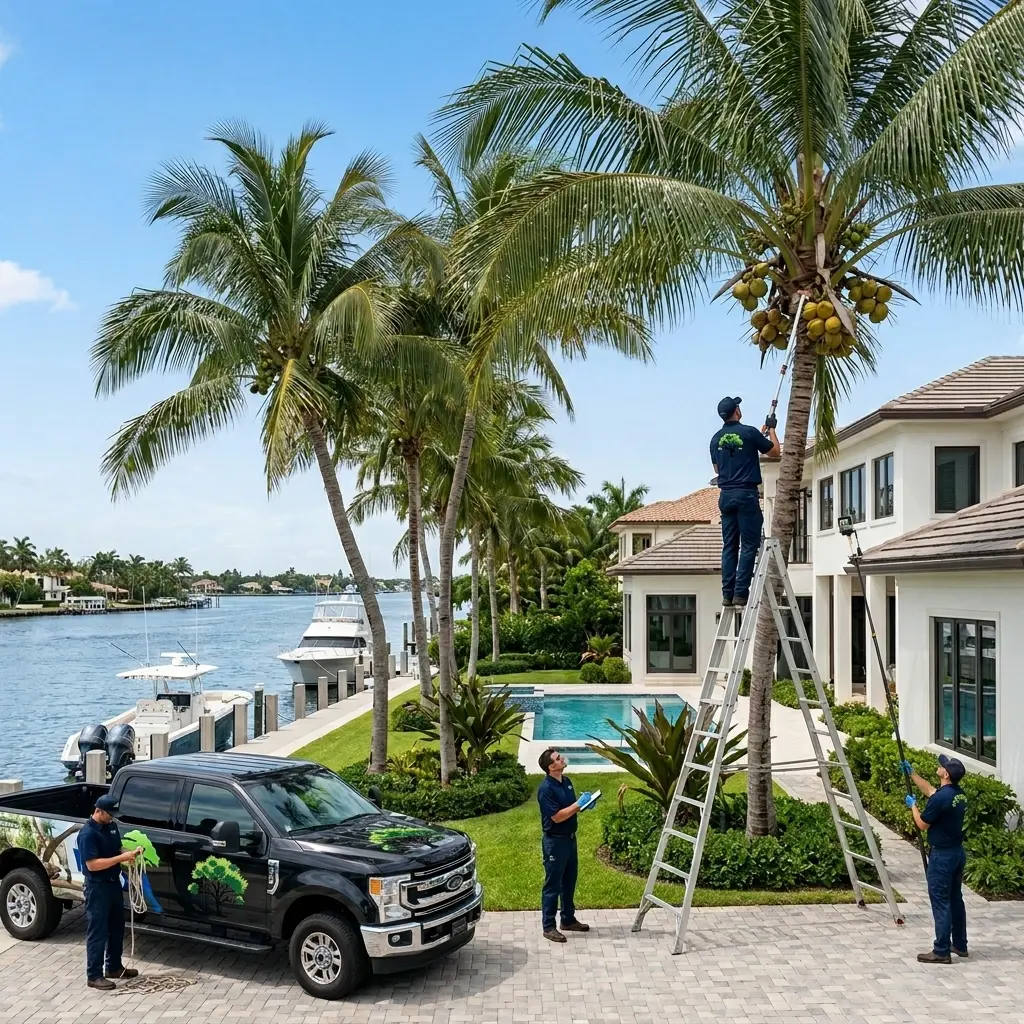
Fruit removal addresses the primary projectile hazard. Coconuts at any stage of development — from small green nuts to fully mature husked fruit — should be removed before storm season. Even partially developed coconuts that appear firmly attached can be dislodged by sustained winds. If your coconut palm is within range of a structure, vehicle, pool, or pedestrian area, removing the fruit before June is the highest-priority action.
Fruit stalk removal addresses a secondary hazard that most non-specialist crews overlook. Once the coconuts are removed, the woody peduncles (stalks) remain. These should be cut close to the trunk to eliminate their surface area as a wind catcher and reduce the weight load on the crown during a storm.
Frond trimming follows the same standard that applies to all palms in Palm Beach County: remove fronds below the horizontal 9 o’clock to 3 o’clock position, dead fronds, and any material showing signs of disease or pest damage. Do not remove healthy green fronds above the horizontal line — this is the hurricane cut error that damages the apical bud and depletes nutrient reserves. (For a full breakdown of why the hurricane cut is harmful, see our guide to the hurricane cut mistake in Palm Beach County.)
All three of these — fruit, stalks, and fronds — need to be addressed. When you schedule pre-season service for your coconut palms, confirm that the scope includes all three before work begins.
How to Assess Your Coconut Palms Before Calling a Professional
A simple visual assessment from the ground will tell you most of what you need to know before scheduling service. Here’s what to look for:
Fruit load. Stand back from the palm and look at the crown. Are there visible coconuts — green or ripe? How many clusters? A palm carrying one or two small clusters in early spring may need attention within a few weeks. A palm carrying five or six full clusters of mature coconuts as June approaches needs attention now.
Proximity to structures. What is within the fall radius of the palm? This is roughly the height of the palm in all directions. A 30-foot coconut palm has a 30-foot fall radius. If your vehicle, pool cage, roof, fence line, or a neighbor’s property falls within that radius, the risk profile is elevated regardless of the coconut load.
Dead fronds and boot accumulation. Are there brown fronds hanging in the canopy? Are old dried frond bases (boots) accumulating on the trunk? These are loose materials that become airborne in a storm separately from the coconuts themselves.
Crown condition. Look at the crown shaft — the smooth column at the top of the trunk. Does it appear vertical and intact? Any visible bend, crack, or distortion in the crown shaft is a structural concern that goes beyond pre-season trimming and requires arborist assessment.
Trunk condition. Any visible cracks, soft spots, or discoloration on the trunk below the crown? Coconut palms with compromised trunks have a higher failure risk in high winds regardless of how well they’ve been trimmed.
If you see significant fruit load, proximity to structures, or any structural concerns, don’t wait until May to call. The window for pre-season service fills up across Palm Beach County every April.
What Coconut Palm Pre-Season Service Actually Looks Like — and Red Flags to Watch For
A professional pre-season service on a coconut palm in Palm Beach County should follow a specific sequence. Here’s what correct looks like — and what to watch for if something is off.
Assessment first. Before anyone climbs or extends equipment to the crown, an assessment of the palm’s condition should happen from the ground. Crown shaft integrity, trunk condition, root zone, overall lean. This takes five minutes and is the basis for every decision that follows. If a crew arrives and immediately starts rigging without looking at the tree, that’s a red flag.
Fruit and stalk removal first. Coconuts and their stalks should be removed before frond trimming begins, for a practical reason: trimming the fronds first can dislodge loosely attached fruit that then becomes a falling hazard during the remainder of the job.
Correct frond removal. Following the 9–3 horizontal rule — only fronds below the horizontal line, dead fronds, and diseased material. The crown should look maintained, not stripped. A coconut palm with fewer than 8–10 visible fronds after trimming has almost certainly been over-trimmed.
Full cleanup and haul-away. Coconuts, stalks, fronds, and all removed material should leave the property. Coconuts left in a pile at the curb or behind a fence are still a potential hazard in a storm and create secondary cleanup issues.
Red flags during the process:
- Crew proposes removing all fronds — the hurricane cut. This is incorrect technique and will damage the palm.
- No assessment of the crown shaft or trunk condition before work begins.
- Fruit left on-site after service is complete.
- No written estimate before work begins — price discussed only after the crew is already on the property.
- No proof of insurance or licensing when asked.
Timing — When to Schedule Coconut Palm Pre-Season Service in South Florida
Hurricane season begins June 1. The practical window for pre-season coconut palm service in Palm Beach County is March through mid-May.
Trimming earlier — in January or February — may leave the palm needing a second service before the season if it produces a new fruit cluster in the spring, which coconut palms in South Florida’s climate often do. March through April hits the right balance: late enough that most spring fruit development is visible, early enough to avoid the scheduling crunch.
By late April and into May, tree service companies across Palm Beach County are at peak demand. Homeowners in Wellington, Delray Beach, and Boynton Beach who call in the first week of May are often looking at 3–4 week wait times. Scheduling in March or early April typically means same-week or next-week availability.
One nuance specific to coconut palms: fruit development is continuous. Unlike seasonal-fruiting trees, coconut palms in South Florida produce fruit year-round under favorable conditions. A palm that was cleared of coconuts in April may have visible new fruit by late May or early June. If you have palms in high-risk locations — directly over a driveway, pool, or roof — a second check in late May is worthwhile.
We recommend building coconut palm pre-season service into a regular annual schedule rather than treating it as a one-time event. Every year, before the season. The cost is modest and predictable; the alternative is not.
Coconut Palms Near Your Roof, Pool, or Driveway? Schedule a Free Assessment Now
Coconut Palm Storm Prep Across Palm Beach County — What We Typically See
After working on coconut palm properties across Palm Beach County for over a decade, certain patterns repeat themselves depending on the community and the property type.
West Palm Beach has high concentrations of mature coconut palms in established residential neighborhoods. Properties near the Intracoastal tend to have palms that are older, taller, and carrying more structural history than younger palms in newer developments. Tall mature palms require elevated access equipment — a bucket truck or experienced climbers — and the cost reflects that.
Jupiter and Palm Beach Gardens coastal properties often have coconut palms sited closer to structures than ideal — planted years ago when the palm was small and the risk calculation looked different. Pre-season work here frequently involves close-quarters removal where the drop zone has to be controlled carefully.
Boca Raton and Delray Beach HOA communities often have coconut palms as a landscape standard — sometimes dozens per property entrance or common area. These communities benefit from a scheduled service agreement that covers the pre-season window without requiring each homeowner or the HOA to schedule individually. We’ve set up exactly this kind of arrangement for several communities in these areas.
Boynton Beach, Pompano Beach, and Wellington properties vary widely — from small residential lots with a single coconut palm in the front yard to larger properties with multiple palms at different ages and heights. In all cases, the assessment and the scope of work are determined by the specific palm’s condition and location, not a one-size approach.
If you’re not sure whether your coconut palms need pre-season attention, a free on-site assessment from one of our ISA-certified arborists will give you a clear picture in 15–20 minutes.

Free
On-Site Estimates
- Pricing Guide
What Coconut Palm Pre-Season Service Costs in Palm Beach County
Coconut palm service costs in Palm Beach County depend primarily on tree height, fruit load, and site access. Here are realistic ranges based on work we do across the county:
- Small coconut palm (under 15 ft, light fruit load): $150–$250
- Mid-size coconut palm (15–25 ft, moderate fruit and stalk load): $250–$400
- Tall coconut palm (25+ ft, requiring elevated access): $400–$700+
- Multiple palms on same visit: volume discount typically applies — ask when you call
A few factors that move the price upward: palms directly over a structure or pool cage (requires controlled descent of coconuts), palms accessible only from a neighbor’s property (requires coordination), very heavy fruit loads with multiple clusters, and palms that show signs of structural compromise requiring additional assessment time.
All estimates from ArbolPro Services are free, on-site, and in writing before any work begins. The price on the invoice matches the estimate. For additional context, see our full palm tree trimming service page.
- Fruit and stalk removal included — not just frond trimming
- Multi-palm discount on same-visit service
- All material hauled away — no coconuts left on-site
When to Call a Professional for Your Coconut Palms — And What to Tell Them
Call a professional if any of the following apply to your coconut palms before hurricane season:
- The palm is carrying visible fruit and is within fall range of a structure, vehicle, or pool
- The palm hasn’t been serviced in more than 12 months
- You have multiple coconut palms and aren’t sure which ones are priorities
- The palm is over 20 feet and you’re not confident assessing it from the ground
- You’ve noticed changes in the crown shaft or trunk that weren’t there before
- A previous crew removed all or nearly all fronds — you want an assessment of the palm’s condition
When you call, have the following ready: your address, an approximate count of coconut palms that need attention, their rough height if you know it, and whether any palm is positioned directly over a structure. This lets us give you an accurate time and cost estimate before we arrive.
At ArbolPro Services, our ISA-certified arborists provide free on-site assessments across Palm Beach County — West Palm Beach, Boca Raton, Wellington, Jupiter, Palm Beach Gardens, Delray Beach, Boynton Beach, and Pompano Beach. Call (728) 209-4532 or request an estimate online.
- Frequently Asked Questions
Coconut Palms Before Storm Season — FAQ
Common questions from Palm Beach County homeowners about coconut palm storm prep.
Why are the bottom fronds of my palm turning yellow?
Yellow fronds at the bottom of the canopy are most commonly normal senescence — the palm cycling out old fronds as new ones emerge from the crown. This is expected behavior for all palm species. If the upper canopy and new growth look green and healthy, and the yellowing is progressing slowly over months rather than weeks, no action is needed beyond removing the dead fronds when they are fully brown. If the yellowing is advancing rapidly or involves fronds higher in the canopy, read on for other potential causes.
What is the most common reason palm trees turn yellow in South Florida?
Potassium deficiency is the most common cause of palm yellowing across Palm Beach County and South Florida generally. Sandy soils leach potassium rapidly, and many landscape fertilizer programs use turf fertilizers that are low in potassium. The symptom pattern is tip-and-margin yellowing on older fronds that progresses inward. Treatment requires a palm-specific slow-release fertilizer with adequate potassium — not standard turf fertilizer, which can worsen the condition.
Can a yellow palm tree be saved?
It depends on the cause. Nutritional deficiency — potassium or magnesium — is treatable, and affected palms can recover fully with correct fertilizer applications over 12–18 months. Overwatering stress can be reversed if caught early. Lethal Bronzing disease cannot be treated in an infected palm — it is fatal once symptoms appear. A palm showing yellowing from Lethal Bronzing will die. The urgency of diagnosis is highest for palms showing rapid, top-down or mid-canopy yellowing, particularly on susceptible species like Date Palms and Bismarck Palms.
How do I know if my palm has Lethal Bronzing?
The earliest signs of Lethal Bronzing are often missed: premature fruit drop and flower spike necrosis before any frond yellowing appears. When frond yellowing does begin, it typically starts at the bottom of the canopy and moves upward, but progresses rapidly — weeks rather than months. The spear leaf — the apical frond at the very top, still unopened — eventually collapses. If you have a Date Palm, Bismarck Palm, Sabal Palm, or Foxtail Palm showing any of these symptoms, call an arborist rather than waiting to see how things develop.
Should I cut off yellow palm fronds?
Yellow fronds that are still partially green are still photosynthesizing and providing nutrient reserves to the palm — do not remove them. Removing yellow-green fronds accelerates nutrient depletion, which can worsen deficiency symptoms. Wait until a frond is fully brown and dry before removing it. Never remove more than the fronds below the horizontal 9–3 line in a single trimming session, regardless of their color. Over-trimming — particularly removing too many fronds at once — stresses the palm and can compound an existing nutritional problem.
The Bottom Line
Coconut palms before storm season require specific attention that a standard trim doesn’t always cover. The fruit, the stalks, the fronds — all three need to be addressed, in the right sequence, by someone who knows the difference between maintaining a palm and damaging one.
In Palm Beach County, where coconut palms are common on residential and commercial properties from Jupiter to Pompano Beach, the window for pre-season service fills up every spring. Scheduling in March or April typically means same-week availability. Waiting until May means waiting in line.
If your coconut palms are carrying fruit and are within range of anything you care about protecting, the time to act is before the season — not during it.
- Get Started
Need a Free Quote in Palm Beach County?
Need a free quote in Palm Beach County? Contact ArbolPro Services today or call (728) 209-4532. We serve West Palm Beach, Boca Raton, Wellington, Jupiter, Palm Beach Gardens, Delray Beach, Boynton Beach, and Pompano Beach.
Free estimates Mon–Sat · ISA-Certified Arborists · Same-week availability March–April
✓ Licensed & Insured ✓ Written Quote ✓ Fruit & Stalk Removal Included ✓ Palm Beach County